

On October 31, 2025The 10th PKU Global Health Leadership Dialogue was successfully convened by PKU Institute for Global Health and Development (GHD). John Wilmoth, Director of the United Nations Population Division and former Professor of Demography at the University of California, Berkeley, delivered an academic presentation focusing on two major themes: "Re-examining Global Urbanization: What's New in the 2025 World Urbanization Prospects Report?" and "The Future of World Population and Global Health: Divergent Trends, Competing Narratives, and the Role of the United Nations." Following the presentation, he engaged in in-depth discussions with experts and scholars from Peking University and multiple research institutions. The dialogue was chaired by Professor Liu Guo'en, Dean of GHD, who extended gratitude and a warm welcome to John Wilmoth on behalf of the Institute.
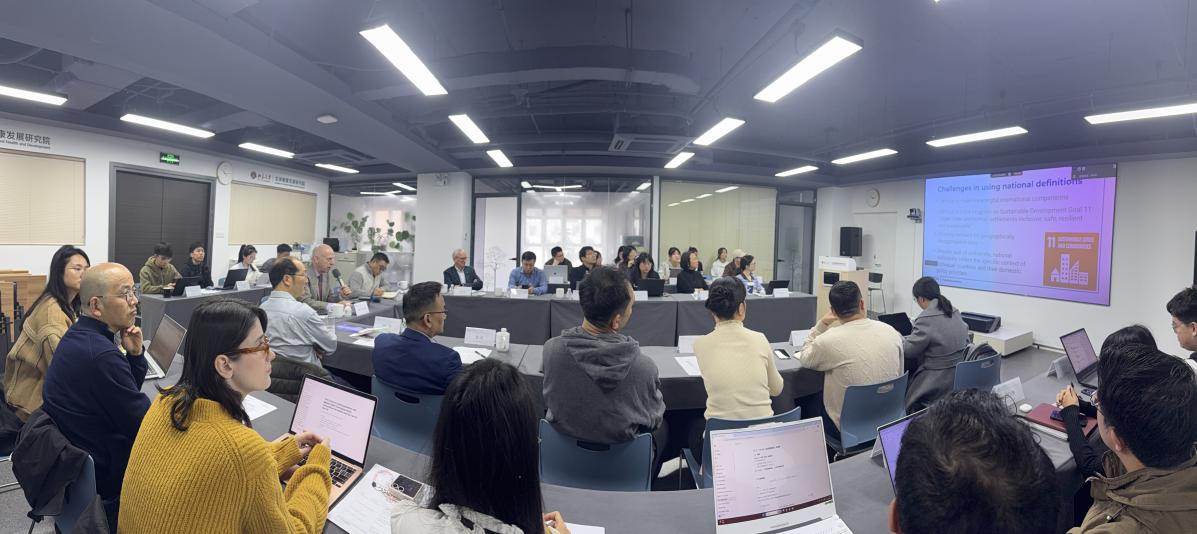
Professor John Wilmoth delivered an academic presentation.
Professor John Wilmoth shared innovative methodologies for measuring global urbanization, providing new perspectives and methodological support for international comparative research. He provided a detailed introduction to the forthcoming update of the United Nations' World Urbanization Prospects report and highlighted that over the past few decades, the absence of a globally standardized definition of "urban" has posed significant challenges to comparative studies on urbanization. To address this, the United Nations has adopted the "Degree of Urbanization" classification method promoted by the European Commission, which relies solely on population size and density for assessment, independent of national administrative definitions. This new methodology will evaluate urbanization across more than 12,000 cities worldwide, marking a substantial expansion in statistical scope compared to the 1,900 cities assessed in 2018. Professor John Wilmoth emphasized that the implementation of the "Degree of Urbanization" is not intended to replace national administrative definitions but rather to complement them, enabling countries to conduct global comparisons using a unified statistical framework. According to this new standard, global population growth since 1950 has been predominantly concentrated in urban areas, with rural regions experiencing slower growth. Currently, there are 33 megacities with populations exceeding 10 million, most of which are located in Asia. This number is projected to increase to 37 by 2050.

The participating guests engaged in enthusiastic and substantive discussions
During the discussion session, Professor John Wilmoth noted that following the adoption of the globally standardized "Degree of Urbanization" methodology, China and India have exhibited greater similarities in their urbanization trajectories than previously understood. The participating experts also engaged in in-depth discussions on the interplay between global urbanization and population aging. Data indicate that global life expectancy has reached 73.5 years and is projected to rise to 77 years by 2050. Although the global population continues to grow at an annual rate below 1%, the pace is slowing, with the population expected to peak at approximately 10.3 billion in the 2080s. The experts unanimously agreed that the introduction of the "Degree of Urbanization" as a unified statistical framework for assessing global urbanization not only enhances the comparability and scientific rigor of urbanization metrics but also establishes a robust foundation for promoting inclusive and sustainable urban development worldwide.

The roundtable discussion was chaired by Professor Bernhard Schwartländer
At the same time, the global population is undergoing a narrative shift from "explosive growth" to "aging and decline," presenting a complex landscape characterized by low fertility rates in developed countries alongside continued growth in certain regions. This transformation underscores the profound implications of demographic changes for sustainable development, social security systems, and the international balance of power. The presentation reviewed the historical evolution of United Nations population issues, with particular emphasis on the significant innovation of the 1994 International Conference on Population and Development in Cairo—shifting the focus from collective demographic targets to a human-centered development approach centered on reproductive health, women's rights, and individual choice. Wilmoth noted that the Cairo consensus remains highly relevant today, and nations should address demographic transitions through comprehensive measures encompassing education, healthcare services, and economic support, all grounded in respect for reproductive rights. By continuously publishing authoritative reports such as the World Population Prospects, the United Nations Population Division provides a scientific basis for global policymaking, contributing to the achievement of an inclusive and sustainable future.

Professor Liu Guoen delivered the concluding remarks
In his concluding remarks, Professor Liu Guoen stated that population aging is a reflection of social progress, and the real challenge lies in how society can adapt to this trend by improving healthcare, family policies, and sustainable urban planning. He particularly emphasized that "our goal should be to help families make informed choices and create more favorable conditions for them."


