

Population aging is a global challenge that is profoundly affecting countries’ ability to provide affordable healthcare services. As life expectancy rises, many countries are facing sustained growth in demand for high-cost medical care, placing unprecedented fiscal pressure on social health insurance systems. China, as one of the countries with the world’s largest elderly population and fastest pace of aging, faces a major question concerning the health and well-being of 1.4 billion people: how to improve health insurance benefits while maintaining fund sustainability.
GHD joint professor Yi Junjian, together with Jonathan Gruber of the Massachusetts Institute of Technology, Lin Mengyun of Xiamen University, and Yang Hanmo of Renmin University of China as co-first authors, conducted a collaborative study reviewing China’s achievements in health insurance coverage, financial protection against medical risks, and health outcomes. The study analyzes the challenges that rapid population aging poses to the sustainability of health insurance funds, and discusses the progress and future directions of two policy explorations: integrated medical and elderly care, and long-term care insurance.
The study, titled “China’s Social Health Insurance in the Era of Rapid Population Aging,” was published in JAMA Health Forum, a leading journal in the field of health policy.
Figure 1. The article was published in JAMA Health Forum
Over the past three decades, driven by low initial premiums, substantial government subsidies, and strong social mobilization, China’s social health insurance coverage has risen from less than 30% to more than 95%. This has marked major progress toward universal health coverage and has generated significant health and economic benefits. At the same time, however, profound demographic changes are placing pressure on the sustainability of the health insurance system. As China’s total population enters negative growth and the proportion of older adults continues to rise, hospitalization rates and per capita medical spending among older adults have increased rapidly, at a pace far exceeding that of other age groups. Through decomposition analysis, the study finds that from 2012 to 2020, demographic changes alone contributed approximately 18% of the total growth in medical expenditure. This estimate does not yet fully reflect the higher medical needs and care dependence of the aging population.
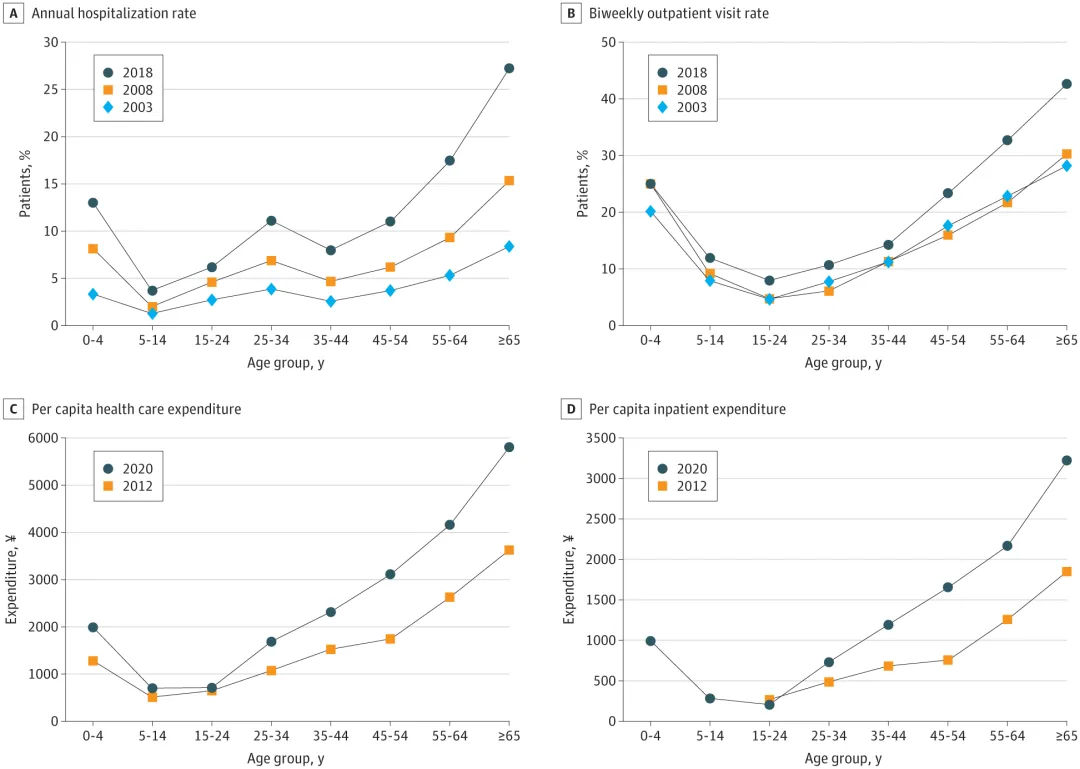
Figure 2. Healthcare utilization rates and medical expenditure by age group
There are gaps in financing capacity and benefit protection across China’s different health insurance schemes, with particularly acute pressure on the funds of Urban and Rural Resident Basic Medical Insurance. Although out-of-pocket health expenditure as a share of total health expenditure has generally declined, the increase in individual contributions has far exceeded the growth in disposable income among rural residents, creating significant financial pressure for low-income groups. Since 2019, enrollment in Urban and Rural Resident Basic Medical Insurance has declined by more than 80 million people in total. How to consolidate the enrollment base and maintain the risk-pooling capacity of the fund has become an important issue for the long-term stable operation of the system.
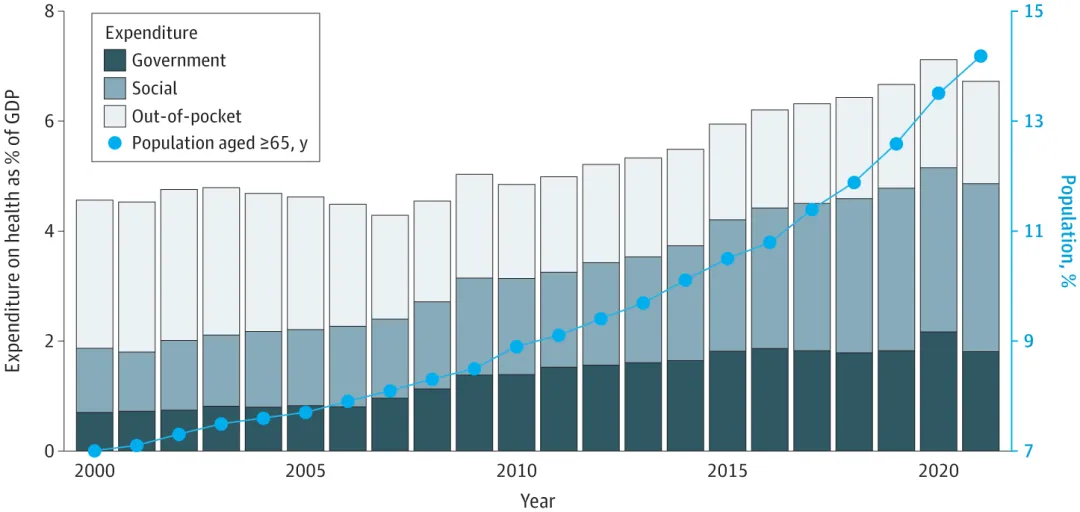
Figure 3. China’s total health expenditure as a share of GDP and the proportion of the elderly population
The study points out that integrated medical and elderly care and long-term care insurance are two important policy explorations for addressing aging and easing pressure on health insurance funds. In March 2026, the General Office of the Communist Party of China Central Committee and the General Office of the State Council issued the Opinions on Accelerating the Establishment of a Long-Term Care Insurance System, marking the formal transition of long-term care insurance from local pilots to nationwide implementation. Existing studies generally find that long-term care insurance has positive effects in reducing unmet care needs, lowering medical utilization and expenditure, and improving the quality of life of older adults and their families. However, there are significant differences across regions in covered populations, benefit standards, and financing mechanisms. Its long-term sustainability and direct causal effects on household well-being remain to be further evaluated.
This study systematically reviews the achievements and challenges in the development of China’s social health insurance system, providing policy reference for building a more resilient and equitable health and long-term care system. As an important case in the global aging process, China’s experience also offers distinctive insights for developing countries seeking to advance universal health coverage and respond to the challenges of population aging.
Article Information
Gruber J, Lin M, Yang H, Yi J. China’s Social Health Insurance in the Era of Rapid Population Aging. JAMA Health Forum. 2025;6(4):e251105. doi:10.1001/jamahealthforum.2025.1105
Original article link: https://jamanetwork.com/journals/jama-health-forum/fullarticle/2833037
Author Biographies

Jonathan Gruber is the Ford Professor of Economics and Chair of the Department of Economics at the Massachusetts Institute of Technology. He previously served as Director of the Health Care Program at the National Bureau of Economic Research and President of the American Society of Health Economists. His research focuses on public economics and health economics, with particular attention to social insurance, healthcare reform, and tax policy. He has published more than 180 papers in leading international academic journals, edited six academic volumes, and authored Public Finance and Public Policy, a widely used undergraduate textbook in the United States. He previously served as Deputy Assistant Secretary for Economic Policy at the U.S. Department of the Treasury, was one of the principal architects of healthcare reform in Massachusetts, and played a major role in the development of the Patient Protection and Affordable Care Act, also known as Obamacare. He was among the first recipients of the American Society of Health Economists’ award for the best health economist in the United States aged 40 and under, and has received honors including a Guggenheim Fellowship. He was named by Slate as one of the “25 Most Innovative and Practical Thinkers of Our Time” and by Modern Healthcare as one of the “100 Most Powerful People in Healthcare.”

Lin Mengyun is an Assistant Professor at the School of Economics, Xiamen University. She received her PhD in Economics from the National University of Singapore in 2022. Her research interests include health economics, applied microeconometrics, and behavioral economics, with a focus on health insurance plan choice, health insurance policy evaluation, and social security. Her work has been published in leading domestic and international journals including the Journal of Public Economics, JAMA Health Forum, Management World, China Economic Review, and Social Science & Medicine. She has led several research projects, including a Young Scientists Fund project supported by the National Natural Science Foundation of China and a Youth Fund project in Humanities and Social Sciences Research supported by the Ministry of Education.

Yang Hanmo is a Lecturer at the School of Population and Health, Renmin University of China. She received her PhD in Economics from Peking University in 2022, and subsequently conducted postdoctoral research at Harvard University and Stanford University. Her research interests include population and labor economics and health economics, with a focus on major issues such as fertility, aging, and healthcare systems. Using methods from economics and demography, her research is grounded in policy-oriented empirical analysis and focuses on how different policy interventions change human motivation and behavior, as well as their broad impacts on health, demographic, and socioeconomic outcomes. Her work has been published in leading domestic and international journals including JAMA Health Forum, The Lancet Public Health, and Population Research.

Yi Junjian is Boya Distinguished Professor at Peking University; Professor of Economics at the National School of Development, Chair of its Academic Committee, and Director of the Center for Future Economic Research; and Co-Principal Investigator of the China Family Panel Studies. He also serves as Executive Editor of China Economic Quarterly and Co-Editor of the Journal of Health Economics. His research interests focus on medical and health economics, the economics of artificial intelligence, human capital theory, labor and population economics, development economics, econometrics, and behavioral economics. His research has been published in leading international academic journals across economics, management, demography, and public health, including the Journal of Political Economy, Review of Economic Studies, Management Science, Demography, The Lancet, and Proceedings of the National Academy of Sciences.


