

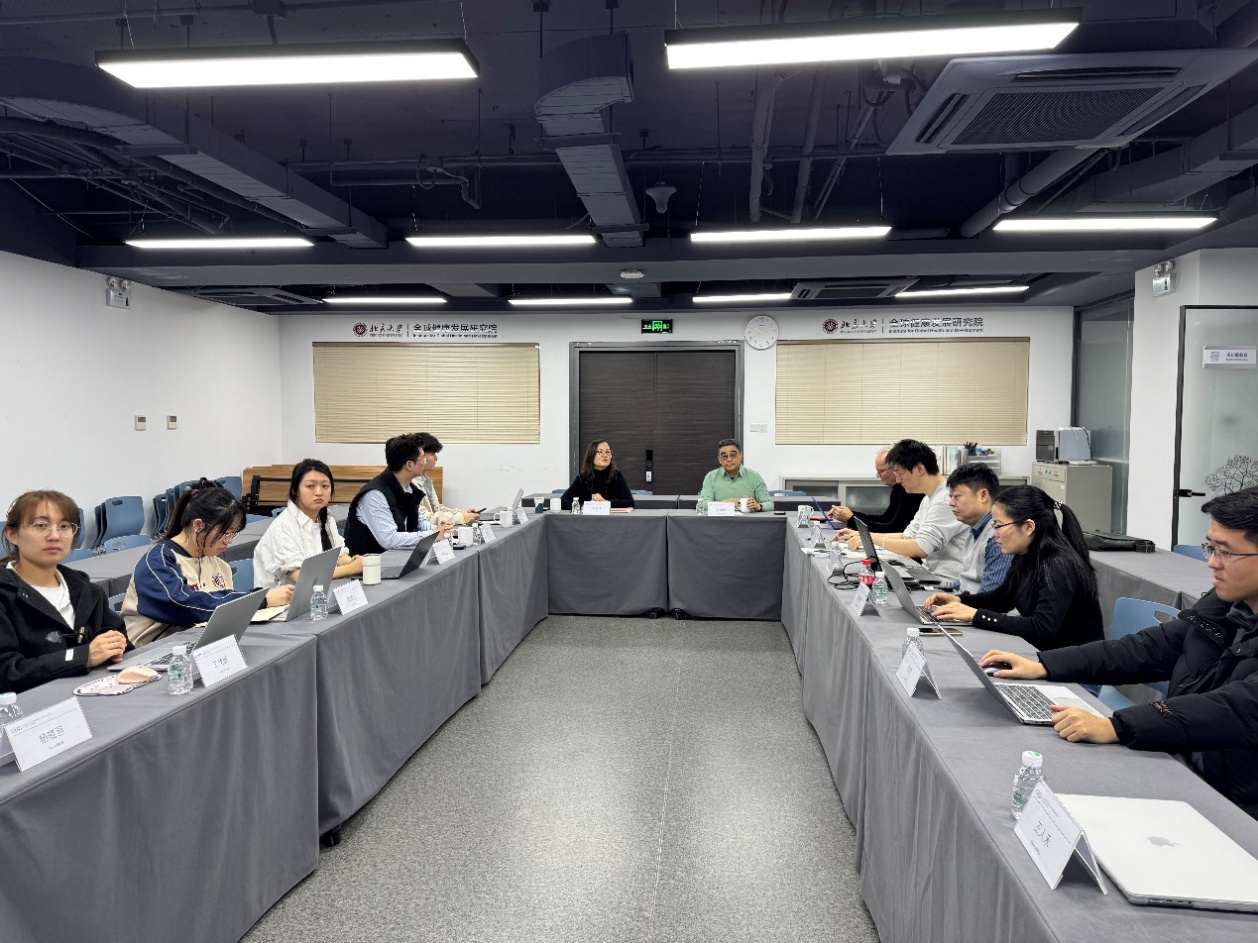
On February 5, 2026, Prof. Zhang Yawei, Director of the Department of Prevention and Control at the National Cancer Center and Deputy Director of the National Clinical Research Center for Malignant Tumors of the Cancer Hospital, Chinese Academy of Medical Sciences, led a delegation to the Peking University Institute for Global Health and Development (GHD). The two teams jointly explored core topics including the health economics of digital health technologies in cancer prevention and the design of multicenter real-world studies, aiming to advance the strategic transformation of national cancer prevention and control from a treatment-oriented approach to prevention-first. Prof. Gordon G. Liu, Dean of Peking University Institute for Global Health and Development, Bernhard Schwartländer, PKU Distinguished Chair Professor of Global Health, as well as faculty members and students from GHD attended the meeting.
At the meeting, Sun Peiyuan, a PhD candidate at the Chinese Academy of Medical Sciences, presented the severe situation of national cancer prevention and control. Data shows that China has the world’s highest incidence and mortality rates of malignant tumors, with a continuously growing disease burden. Nevertheless, approximately 40% of cancers can be prevented through effective primary prevention strategies, with enormous potential in tobacco control, a healthy diet, HPV vaccination and other fields. Sun Peiyuan pointed out that digital health technologies provide new tools for cancer prevention; for example, mHealth-based lifestyle intervention platforms can significantly improve users’ behavioral habits through risk assessment and real-time feedback, yet their health economic benefits still require systematic evaluation.
The two teams conducted an in-depth discussion on the current limitations of research on cancer primary prevention. Prof. Zhang Yawei noted that existing health economic evaluations mostly focus on single cancer types such as gastric cancer (Helicobacter pylori prevention and control) and cervical cancer (HPV vaccination), while there is a lack of systematic research on the synergistic impacts of composite risk factors such as smoking and obesity on multiple cancers. Prof. Gordon G. Liu suggested collecting data on direct medical costs, labor loss and subjective economic burden by combining real-world follow-up cohorts. Prof. Bernhard Schwartländer stated that a comprehensive lifestyle intervention covering smoking cessation, alcohol restriction and physical exercise may reduce the risks of lung cancer, liver cancer and breast cancer simultaneously, but existing models are unable to quantify such cross-benefits.
The meeting reached a consensus on the follow-up cooperation directions: the two teams will jointly advance a national survey on the economic burden of cancer covering seven major regions of China. It is planned to collaborate with seven institutions including Heilongjiang Cancer Hospital and Zhejiang Cancer Hospital to recruit 1,400 newly diagnosed cancer patients, and track their direct and indirect costs throughout the entire course of the disease through a two-year follow-up. Prof. Gordon G. Liu stated that this research is of great significance, as it will help fill the gap in the data on the long-term economic burden of high-incidence cancers in China, and especially provide evidence for evaluating the "hidden benefits" of primary prevention (such as reducing poverty caused by illness).
In addition, the two teams plan to jointly build a Health Economics Decision Support Platform for Cancer Prevention, which will integrate data on risk factor exposure, intervention costs and disease burden to provide a dynamic simulation tool for policy-making. The platform can calculate the differences in cost-effectiveness of promoting HPV vaccination or enacting tobacco control legislation in different provinces, supporting the precise allocation of resources. The interdisciplinary innovation of digital health and health economics is expected to become a "China Solution" for reducing the cancer burden.


