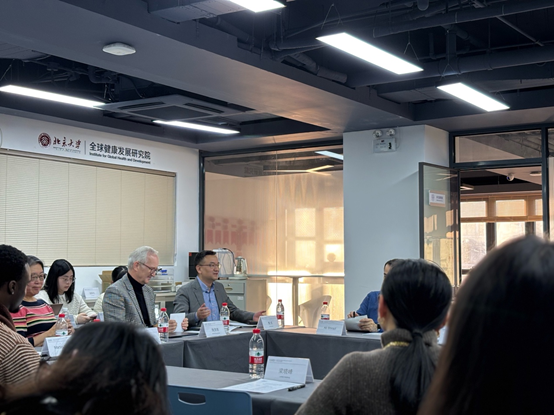
On January 21, 2026, the Peking University Institute for Global Health and Development (GHD) successfully held the 12th session of the " PKU Global Health Leadership Dialogue". Dr. Vivian Lin, Honorary Professor of the University of Hong Kong and former Director of the Health Systems in the Western Pacific Region at the World Health Organization (WHO), was invited as the keynote speaker for this session. An academic discussion was held on the theme of "Why is Policy Implementation So Challenging? Political Economy Matters", with experts and scholars from multiple institutions including the WHO, the United Nations Children's Fund (UNICEF) China Office, and Peking University participating in the dialogue and exchange. Bernhard Schwartländer, PKU Distinguished Chair Professor of Global Health, presided over the dialogue. Prof. Gordon G. Liu, Dean of GHD, delivered a welcome speech, and Prof. Huang Cheng, Assistant Dean of GHD, concluded the dialogue.
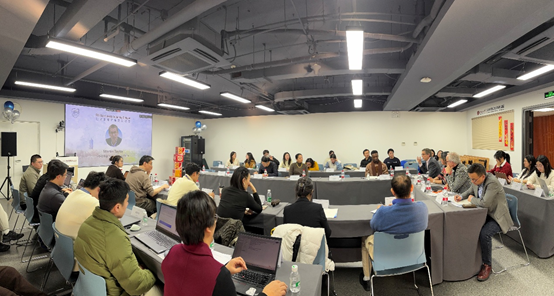
In his online speech, Prof. Gordon G. Liu emphasized that how to drive the effective implementation of health policies and achieve substantive progress in real-world scenarios has long been an important topic continuously explored by the global academic and policy communities. Taking the reform of China's medical and health system as an example, he pointed out that the national medical reform plan as early as 2009 clearly defined several major tasks for future reform, including striving to shift the focus of medical services from tertiary hospitals to community primary health care institutions. To this day, official statistics from the National Health Commission show that over the past few years, although the number of patient visits to community-level health institutions has increased by about 30%, the number of visits to tertiary hospitals has surged by nearly 200%. He stressed that this set of data directly reveals the practical challenges in the process of reform advancement, and the underlying deep-seated reasons are closely related to inter-departmental political economy factors, especially the absolute dominant position of large hospitals in the allocation of resources within the medical and health system.
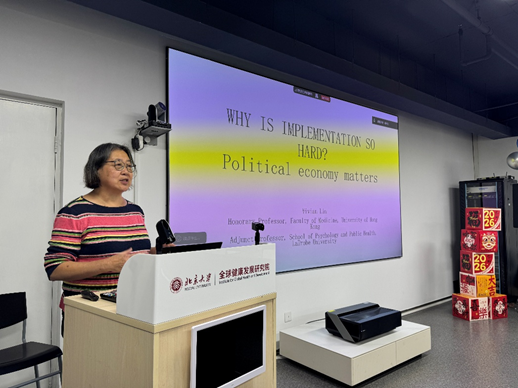
In Prof. Vivian Lin’s presentation, she explored the gap between policy concepts and actual implementation. Despite the substantial research and practical efforts invested in the field of Implementation Science worldwide, the core driving force—political economy factors, namely how power and resources are allocated under conditions of resource scarcity and their profound impact on policy implementation—is often overlooked when solving practical problems. She illustrated this point with a number of cases. For instance, a health minister in Australia with a political science background consolidated the implementation of universal health insurance by funding the establishment of a consumer health forum, which gave patient groups an institutionalized voice in policy-making. In the tobacco control case in Victoria, industry resistance was successfully resolved by using tobacco tax revenue to fund a health promotion foundation and assisting tobacco farmers in transitioning to growing wine grapes. She also mentioned a counterexample: in a rural health project in China, the essential medicine list, originally intended to standardize medication use, was used by grassroots medical institutions as an advertising tool to attract patients in practice. This shows that policy evaluations divorced from actual incentive mechanisms often fail. Prof. Lin called for public health education to go beyond technical tools and incorporate skills such as political analysis, change management and negotiation strategies.
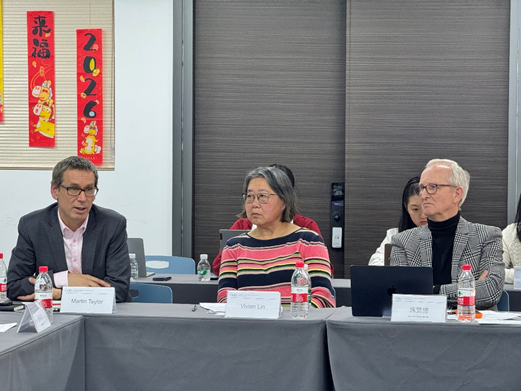
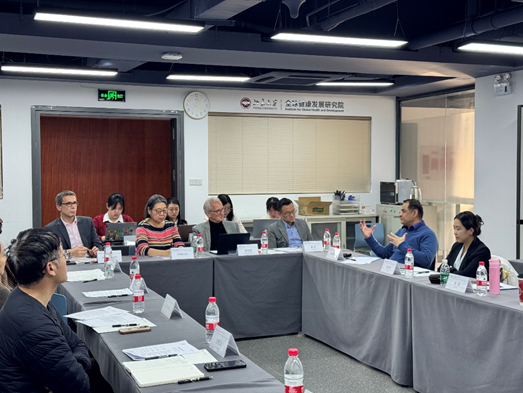
In the discussion session, Martin Taylor, WHO Representative in China, expressed his agreement on introducing the political economy perspective. He put forward an observation: over the past 20 years, China has made slow progress in the integration of primary health care, yet achieved a rapid breakthrough in health insurance coverage, reaching more than 95% of the population. He believed that this dual-track phenomenon is worthy of in-depth research from the perspective of political will and the demand for social stability. Participating experts pointed out that in addition to economic interests, moral considerations and non-financial incentives are also important factors driving behavioral changes. The discussion also touched on the risk of policy dilution in the process of cascading implementation, which results in no real change in the behaviors of frontline implementers, and this requires the establishment of a more effective monitoring system.
In his concluding remarks, Prof. Huang Cheng stated that Prof. Vivian Lin's sharing provided an important perspective for understanding the innovation of complex health systems. All participants reached a consensus: the success of health policies relies not only on technical solutions, but also on the integration of political economy analysis into Implementation Science. By understanding power structures, resource allocation and the motivations of relevant actors, the gap between policy ideals and actual implementation can be effectively narrowed.